Full-arch implant treatment is one of the most life-changing things a dentist can offer a patient with failing teeth or an ill-fitting denture. The All-on-4 concept in particular has made “same-day teeth” familiar to many patients, and more general dentists are asking whether it is something they could learn. This guide explains the principles, what the treatment involves, and the skills you need before taking it on.
What is All-on-4?
All-on-4 is a treatment concept, developed by Paulo Maló with Nobel Biocare in the late 1990s, for restoring a full arch with a fixed bridge supported by four implants. The two anterior implants are placed upright; the two posterior implants are tilted distally, typically by up to about 45 degrees. Tilting the posterior implants lets them avoid the maxillary sinus or the mental foramen, use the available bone more effectively and reduce the cantilever on the bridge – often avoiding the need for sinus or block grafting.
Where primary stability allows, the implants are loaded immediately with a fixed provisional bridge, usually on the day of surgery. The definitive bridge is fitted once the implants have integrated and the soft tissues have settled, typically after a few months. “All-on-many” protocols follow the same principles with five, six or more implants where the anatomy and the case call for it.
Who is it for?
- Patients with a terminal dentition who would otherwise move to complete dentures.
- Denture wearers who struggle with retention, comfort or function, particularly in the lower jaw.
- Patients who want a fixed solution but have limited bone and would prefer to avoid extensive grafting.
Careful assessment matters as much as surgical skill. Medical history, smoking, parafunction, periodontal status, the smile line and the “transition zone” between bridge and gum, and the opposing dentition all affect whether full-arch treatment is appropriate and how it should be designed. The patient also needs to understand the commitment to long-term maintenance.
What the treatment involves
- Planning: CBCT, photographs, records and a prosthetically driven plan, often in software such as DTX Studio Implant, deciding the final tooth position and the amount of bone reduction needed.
- Surgery: extraction of remaining teeth, alveoloplasty to create a flat platform and restorative space, placement of four or more implants with enough insertion torque for immediate loading, and multi-unit abutments to correct the angulation.
- Immediate provisional: a screw-retained provisional bridge, converted from a prefabricated prosthesis or made from a digital design, fitted the same day.
- Definitive bridge: once healed, a stronger final bridge is made – for example a milled framework with acrylic or ceramic teeth.
- Maintenance: regular reviews, hygiene with the bridge removed, and monitoring for screw loosening, wear and peri-implant disease.
Is it a good first implant procedure?
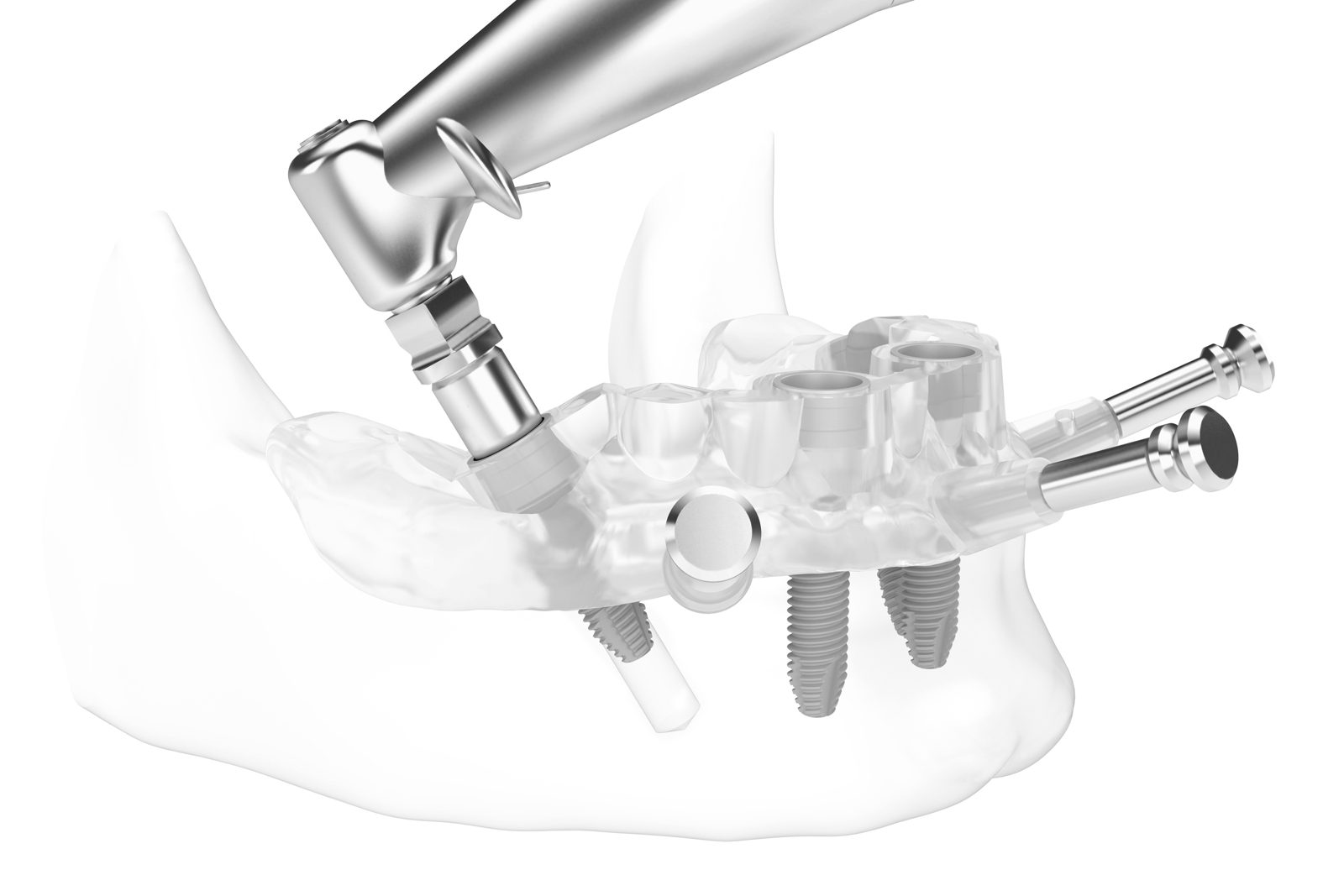
No. Full-arch treatment brings together almost every implant skill at once: multiple extractions, bone reduction, angled implant placement, immediate loading, prosthetic conversion on the day and complex long-term maintenance. It is best approached once you are confident with single-tooth and short-span cases, and with structured training and mentoring for your first full-arch patients. Digital tools, including guided surgery and dynamic navigation, can help with accuracy, but they do not replace that experience – see our guide to guided implant surgery and X-Guide.
In this video, an All-on-4 immediate loading case in the lower arch:
Learning full-arch treatment with Guy’s College
Full-arch restoration is covered on days 5 and 6 of our Certificate in Advanced Implant Dentistry: All-on-4 same-day teeth, All-on-many and immediate loading, taught through lectures, surgical videos, hands-on practicals and live surgery demonstrations. The course is limited to eight participants and taught by Dr David Guy at 18 Wimpole Street, London. If you are new to implants, start with the Certificate in Implant Dentistry; the two years together with a clinical case submission lead to the Diploma in Implant Dentistry.